Lebanon
Lebanon is a Mediterranean country positioned at the intersection of the Levant, the eastern Mediterranean and the wider Middle East. Its strategic importance is shaped by Beirut, a highly connected service economy, a remarkable archaeological heritage, religious diversity, diaspora networks, and a long history of commercial and cultural exchange.
Lebanon at a Strategic Crossroads
Lebanon combines a compact territory with exceptional historical depth, a Mediterranean urban economy and a globally distributed diaspora. Beirut functions as the country's principal economic, cultural, educational and institutional centre.
The country's modern trajectory is also defined by severe financial disruption, political fragmentation, infrastructure pressures and repeated security shocks. At the same time, tourism, services, entrepreneurship, education, culture and diaspora connections remain important sources of resilience.
Country Overview
Lebanon's strategic profile is shaped by its Mediterranean geography, dense urban networks, cultural diversity, historic commercial role and proximity to major regional geopolitical corridors.
Capital: Beirut
The principal political, financial, cultural, media and educational centre of Lebanon and a major eastern Mediterranean urban node.
Mediterranean Geography
A narrow Mediterranean country with a coastal plain, Mount Lebanon, the Beqaa Valley and the Anti-Lebanon mountain system.
Regional Position
Lebanon borders Syria and Israel and faces the eastern Mediterranean, placing it within a highly strategic Levantine environment.
Lebanon Data Profile
Selected current indicators provide a compact statistical picture of the country's demographic and economic position.
History & Geography
Lebanon's geography is compact but exceptionally varied, while its historical record spans thousands of years of Mediterranean exchange.
The Levantine Corridor
Lebanon's coastal position historically connected the eastern Mediterranean with inland Syria and the wider Near East.
Baalbek & Classical Heritage
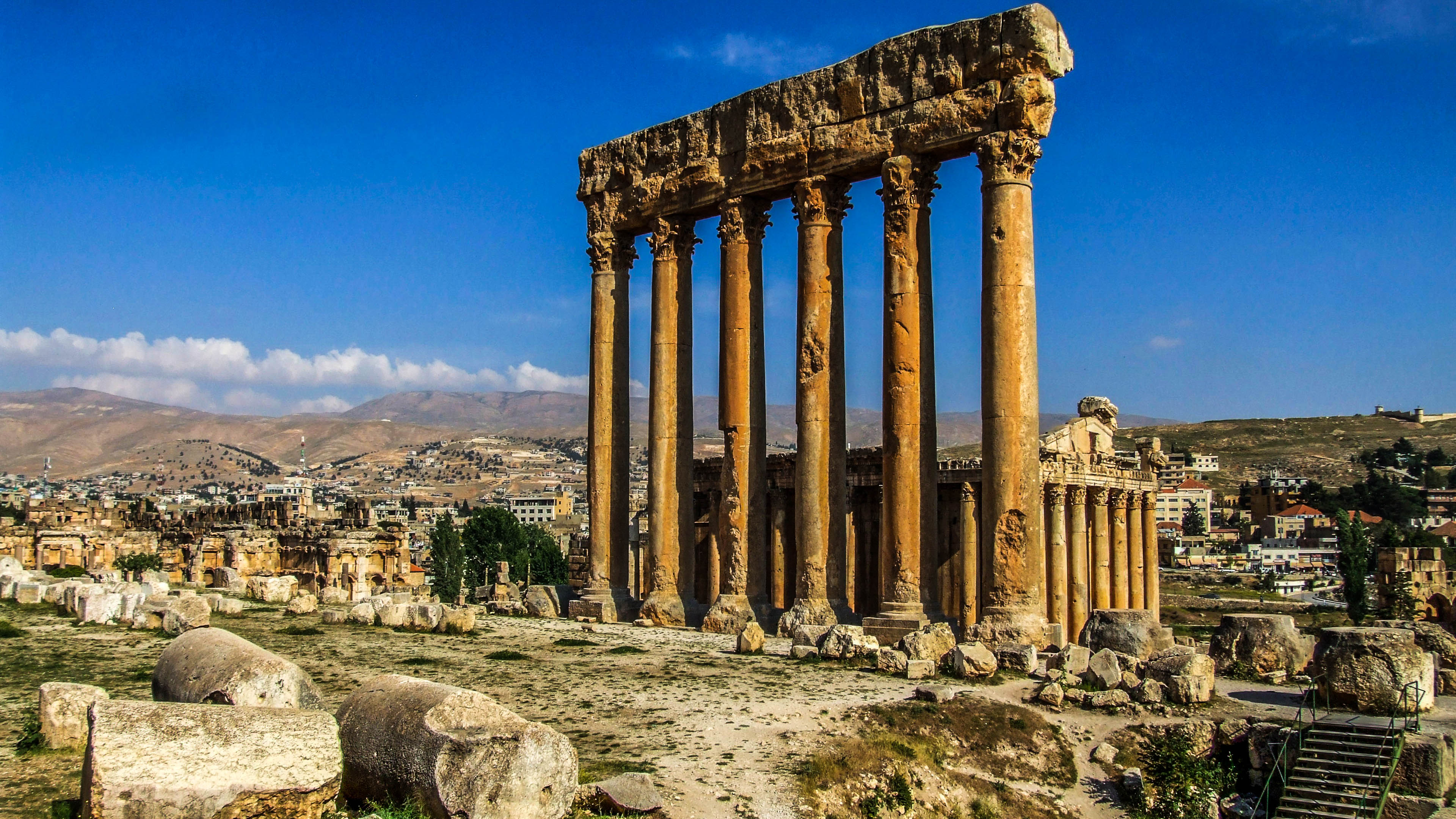
Baalbek illustrates the extraordinary scale of the Roman architectural legacy embedded within Lebanon's ancient landscape.
Civilizations & Historical Layers
Lebanon's historical importance is inseparable from the interaction between maritime commerce, religious institutions, imperial systems and mountain communities.
Economy & Business
Lebanon's economy has traditionally relied heavily on services, commerce, tourism, finance, real estate, education and diaspora-linked financial flows.
Diaspora-linked remittances remain a major source of external income and household resilience.
Inflation remained elevated despite substantial improvement from the extreme price instability of earlier crisis years.
Labour-market recovery remains incomplete and sensitive to economic and security disruptions.
Economic Indicators
The indicators below show the scale and fragility of Lebanon's economic recovery.
Visual indicators are illustrative and are not intended as a common-scale comparison between different units.
Politics & Governance
Lebanon's political system reflects a deeply plural society and a complex balance between communities, institutions and regional forces.
Institutional Balance
Lebanon's governance framework distributes political representation across religious communities and institutions.
Reform Capacity
Banking reform, fiscal management, public administration and service delivery remain central to long-term institutional recovery.
Security Environment
Domestic governance is strongly influenced by regional conflict, border dynamics and the wider geopolitical environment.
Modern Transformation
A compact timeline of the major structural turning points shaping contemporary Lebanon.
Business Ecosystem
Lebanon's private sector has historically demonstrated strong entrepreneurial capacity despite institutional and macroeconomic constraints.
Tourism
Coastal tourism, cultural heritage, mountain landscapes, gastronomy and Beirut's urban culture form a diversified tourism base.
Entrepreneurship
Start-ups, technology firms, creative industries and diaspora networks contribute to Lebanon's entrepreneurial ecosystem.
Trade & Services
Commerce, professional services, education, healthcare and logistics remain important components of the economic structure.
Population & Demography
Lebanon's demographic profile is influenced by low population growth, migration, diaspora connections and the country's role as a host environment for displaced populations.
Education & Human Capital
Education is one of Lebanon's strongest long-term assets, supported by universities, schools, professional networks and a highly educated diaspora.
Science, Technology & Innovation
Lebanon's technology potential is closely linked to education, entrepreneurship, telecommunications, digital services and diaspora expertise.
Digital Entrepreneurship
Technology start-ups and digitally enabled businesses provide opportunities for international market participation.
Research Capacity
Universities provide a platform for research in medicine, engineering, natural sciences and social sciences.
Digital Government
Public-sector digital transformation can improve administrative efficiency, transparency and service delivery.
Healthcare & Social Development
Lebanon has historically developed a strong private and university-linked healthcare ecosystem, while the economic crisis has placed major pressure on affordability and service continuity.
Medical Expertise
Hospitals, universities and medical professionals contribute to a sophisticated regional healthcare network.
Social Protection
Expanding effective social protection remains an important component of economic stabilization and recovery.
Resilience
Healthcare institutions have repeatedly adapted to economic and security shocks while maintaining essential services.
Infrastructure & Digital Transformation
Energy, water, transport, municipal infrastructure and digital public services are central to Lebanon's recovery agenda.
Environment & Climate
Lebanon combines Mediterranean coastline, high mountains, forests, valleys and agricultural landscapes, creating significant environmental diversity.

Cedars of Lebanon
The cedar landscape is one of Lebanon's most internationally recognizable natural and cultural symbols and forms part of the UNESCO-listed Ouadi Qadisha and Forest of the Cedars of God property.
International Relations & Geopolitics
Lebanon's foreign-policy environment is shaped by its geography, relations with neighbouring states, international partners, diaspora networks and wider Middle Eastern security dynamics.
Eastern Mediterranean
Lebanon's maritime position gives it strategic relevance for trade, energy, connectivity and regional security.
Neighbouring States
Relations with Syria and Israel remain central to Lebanon's security and geopolitical environment.
International Partners
European, Arab, international financial and humanitarian institutions remain important to recovery and development.
Security & Human Security
Human security in Lebanon extends beyond military considerations to include economic stability, infrastructure, food security, public services and community resilience.
Historic Cities of Lebanon
Lebanon's urban heritage connects ancient Mediterranean ports, Roman cities, Islamic urban centres and modern commercial hubs.

Byblos
One of the world's most historically important Mediterranean urban settlements and a UNESCO World Heritage property.
Baalbek
A monumental archaeological landscape representing one of the greatest surviving Roman temple complexes.
Beirut: Urban & Cultural Capital
Beirut is simultaneously Lebanon's political centre, business hub, cultural capital, university city, media centre and principal gateway to international networks.

Beirut Urban System
The city reflects Lebanon's distinctive mixture of Mediterranean commerce, modern architecture, historic neighbourhoods, education, culture and entrepreneurial activity.
UNESCO World Heritage in Lebanon
Lebanon currently has seven properties inscribed on the UNESCO World Heritage List, spanning archaeological, architectural, urban and natural-cultural heritage.
Anjar
Umayyad archaeological city · 1984
Baalbek
Roman monumental complex · 1984
Byblos
Ancient Mediterranean city · 1984
Mount Amel Castles
Inscribed in 2026
Ouadi Qadisha & Cedars
Holy Valley and Forest of the Cedars of God · 1998
Rachid Karami International Fair
Tripoli modernist landmark · 2023
Tyre
Ancient Phoenician-Roman city · 1984
Heritage Under Pressure
Lebanon's heritage assets face the combined pressures of conflict, urban development, environmental change and limited conservation resources.
Mount Amel Castles and Tyre were placed on the List of World Heritage in Danger in 2026.
Conservation
Sustainable conservation requires technical expertise, financing, planning and coordination between national and international actors.
Cultural Economy
Heritage conservation can also strengthen tourism, local employment, education and cultural diplomacy.
Faith & Religious Heritage
Lebanon's cultural landscape reflects a long history of Christian and Muslim communities and a distinctive tradition of religious pluralism.
Christian Heritage
Monasteries, churches, pilgrimage landscapes and mountain communities form an important part of Lebanon's historic identity.
Muslim Heritage
Mosques, historic cities, religious institutions and urban traditions represent centuries of Islamic cultural development.
Plural Society
Religious diversity is a defining feature of Lebanese social and political life and an important field for TEDRIC research.
Tourism & Cultural Economy
Lebanon's tourism potential derives from the unusual concentration of archaeological sites, religious heritage, mountains, Mediterranean coastline, cuisine and urban culture.
Heritage Tourism
Baalbek, Byblos, Tyre, Anjar and other historic sites form the basis for an internationally significant heritage circuit.
Mountain Tourism
The Lebanon mountain range provides opportunities for nature, hiking, winter sports and rural tourism.
Gastronomy & Culture
Lebanese cuisine, arts, music, design and creative industries reinforce the country's cultural tourism profile.
Recovery & Reconstruction
Reconstruction is one of Lebanon's most important medium-term development challenges.
Lebanon Strategic Outlook
Lebanon's future trajectory will depend on whether economic, institutional and security reforms can reinforce the country's considerable human and cultural assets.
Recovery
Restoring macroeconomic stability and rebuilding confidence are fundamental to sustainable growth.
Reform
Banking, fiscal, public-sector and infrastructure reforms can create the institutional foundation for investment.
Resilience
Energy, food, healthcare and critical infrastructure resilience will remain strategic priorities.
Human Capital
Education, professional expertise and diaspora networks represent Lebanon's strongest long-term assets.
Cultural Economy
Heritage, tourism, gastronomy, design and creative industries can support economic diversification.
Digital Transformation
Digital public services and technology entrepreneurship offer routes toward greater efficiency and international connectivity.
TEDRIC Research Priorities
Lebanon provides a particularly rich research environment for interdisciplinary analysis.
Economic Recovery
Macroeconomic stabilization, banking reform and investment recovery.
Heritage
World Heritage protection, archaeology and cultural diplomacy.
Geopolitics
Levant security, regional relations and eastern Mediterranean dynamics.
Human Capital
Education, universities, healthcare and diaspora knowledge networks.
Governance
Institutional reform, public administration and service delivery.
Infrastructure
Energy, water, transport, digitalization and reconstruction.
Lebanon Research Dashboard
A concise framework for continuing TEDRIC's interdisciplinary country research.
Research Sources
Core institutional sources supporting the TEDRIC Lebanon country profile.
Lebanon
Lebanon represents one of the Middle East's most distinctive combinations of historical depth, cultural diversity, human capital, Mediterranean connectivity and institutional complexity.
Its future development will depend on the interaction between economic recovery, institutional reform, reconstruction, security, human capital, cultural heritage and international connectivity.